


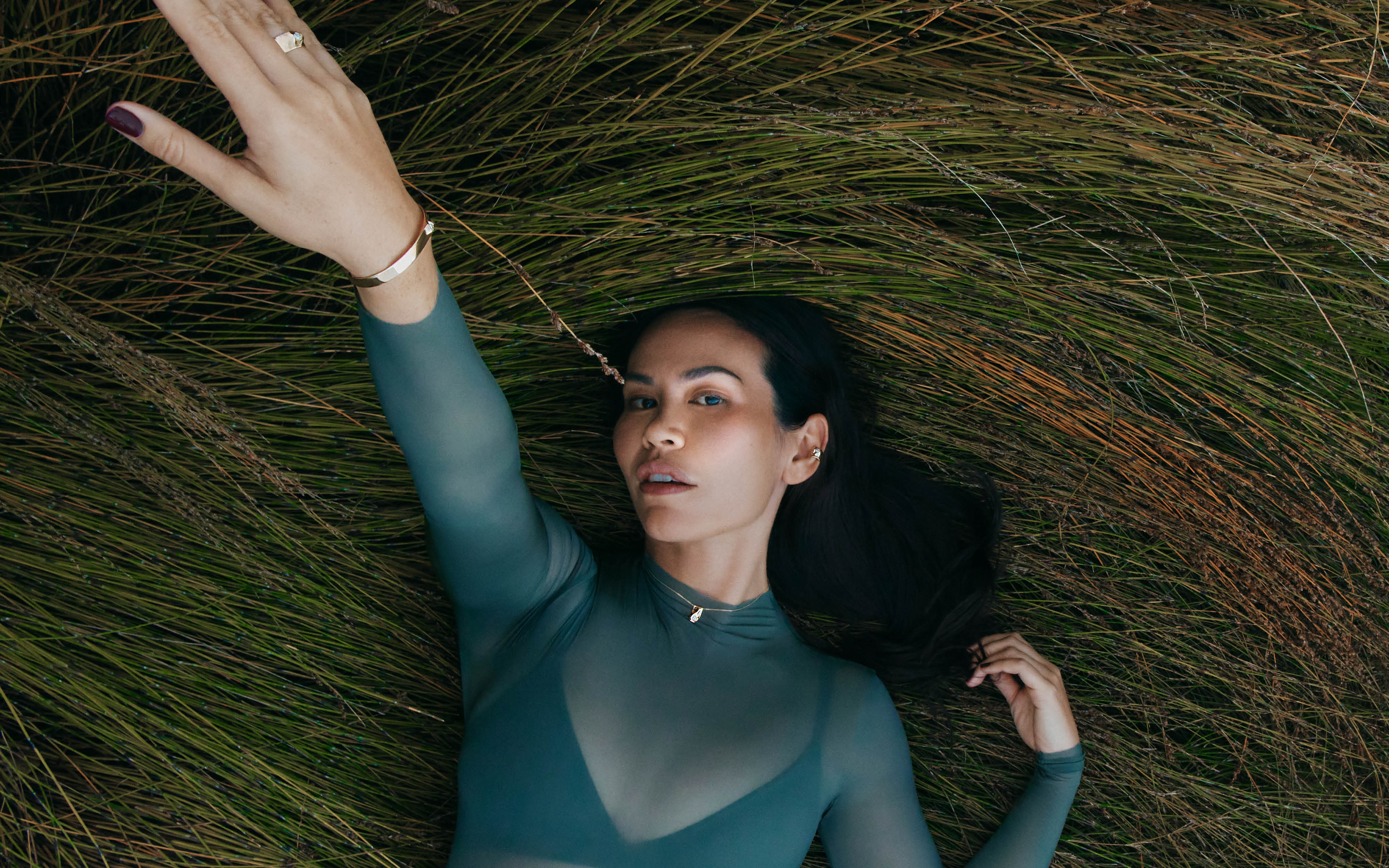
Amrita Hepi: In Rhythm with ONDINE
There is a certain gravity to Amrita Hepi. A choreographer and dancer of Bundjalung (Australia) and Ngāpuhi (New Zealand) heritage, she is an artist whose practice stretches across dance, performance, video, and installation. Her work, often shifting between intimacy and spectacle, investigates the body’s role as a vessel for memory, identity, and cultural narratives.
It is this blend of intellectual rigor and instinctual grace that made Amrita the perfect muse for our ONDINE collection campaign. Against the raw beauty of Aotearoa’s west coast, Amrita translates ONDINE’s sculptural forms into a living movement and grounds the campaign with a meditative body-scan, an invitation to catch our breath.
ONDINE explores themes of ritual and rhythm, our relationship to the natural world, and the transcendent. It was with these ideas in mind that we sat down with Amrita, in the midst of a schedule that spans continents, collaborations, and constant creation, to talk about her creative practice, relationship to ritual, and the elemental pull of nature.
Hi Amrita, can you start by telling us about your creative practice and your history with movement and choreography.
I’m an artist who works with choreography and performance, mostly with liveness. My history with this is long and constantly changing and evolving.

One of the things we’ve thought a lot about as part of ONDINE is the idea of ritual. What practices in your life feel ritualistic, whether through the body, breath, or the way you prepare to move or create?
My rituals tend to be quite mundane, like finding where the water is in a new place, resetting my wardrobe or chucking things out if I’m feeling stressed, eating the same thing every morning in a new place when I’m in a kind of mini routine. And then in regards to preparing to move or make something, I don’t know if it’s a ritual but I have to get myself into a zone whereby I am kind of tricking myself into thinking: “I am just taking notes, I am just moving to sense things out, this is just a few small words, moves, a sketch,” in order to get myself to begin with lots of options and an intimacy without creating a pressure cooker of an environment. It’s simultaneously focused and also can look like dithering or distraction in the beginning. And miraculously I repeat this focused/distracted dance a lot, hence maybe it’s now a ritual.
“I AM JUST TAKING NOTES, I AM JUST MOVING TO SENSE THINGS OUT”

How do you create moments of stillness or presence in your daily life?
With great effort, with repetition, without trying to do too much.
How does nature influence your creativity or sense of self?
By giving it the attention and the respect it deserves. By trying not to project myself into every part of it. By knowing that there is Vā [the sacred, relational space that binds people, nature, and spirit] between myself and it.
What aspects of filming the campaign and wearing the collection resonated with you, and how did they connect to your sense of movement and style?
Being in Aotearoa, one of my homes, and taking part in a Karakia [a traditional Māori prayer to invoke spiritual guidance and protection] at the start of shooting, and of course, I loved the earrings I got to wear. They felt like they would stay put even if I was moving a lot. I always think dancers have great style, and I have always said my own style is lazy with elegant aspirations (or fast and relaxed), so I love jewellery that can stick with me, that I can forget about until I put it on in the morning and it makes me smile. That doesn’t get stuck in my hair, that I can swim in, run in, and that lives on me and with me.
“I LOVE JEWELLERY THAT CAN STICK WITH ME, THAT I CAN FORGET ABOUT UNTIL I PUT IT ON IN THE MORNING AND IT MAKES ME SMILE.”
Which piece from the collection resonates with you most, and why?
All of the earrings. Every single pair.
The campaign was filmed on the west coast of Aotearoa, a place rich in elemental energy and connected to your heritage. How did being in that landscape shape your experience of movement and creation during the filming?
There was a great reverence with shooting there. I thought a lot about Taniwha and Whenua. And I really loved having Rae, the makeup artist who was local, and Matt who works at Sarah & Sebastian, on the shoot with me, two people that understood the complexity of the Tangata Whenua.

What do you hope others feel after experiencing your movement or being present with your work?
Every work is very different, and I’m not in the business of dictating hope to a room or an audience. I am however in the business of ideas, experiences, rigour and movement. I hope that no one ever says: Amrita’s works all look the same, and that’s why I am here.
Many. But at present I have just finished a full and happy few months of making a new work called The Act for Rising Festival, working with my sister on a new show at Passage, and beginning the European tour leg of Rinse at Avignon Festival. The thing I am looking forward to is sleeping and swimming. But also, if Sophie Calle or Michelle de Kretser are reading this, let’s have a drink and talk about collaboration. On me!
Recommended

In Conversation: Robert Sebastian Grynkofki on Design, Fatherhood, and Legacy
Ahead of Father’s Day, we photographed Robert, Co-Founder and Product Director of SARAH & SEBASTIAN, with his son Otto near their home in Sydney. He reflects on how fatherhood has shaped his sense of legacy, speaks to the future of men’s jewellery, and draws parallels between automotive design and fine jewellery craftsmanship. Robert wears the Valentine Necklace, the Bold Hoop and the Traction Diamond Signet Ring. How would you describe your personal style? Understated, with a focus on subtle details and clean lines. I gravitate toward quality materials and thoughtful design rather than overt logos or trends. There’s often a sentimental layer to what I wear - many pieces, including sneakers, have been collected over years of travel or mark certain chapters in my life. Some reflect more rebellious times. I like the idea of quiet luxury, but for me, it’s more about the feeling a piece evokes and how it was made. “FOR ME, IT’S MORE ABOUT THE FEELING A PIECE EVOKES AND HOW IT WAS MADE” Robert wears the Lock Bangle, Lock Cord Bracelet, Fine Soldered Chain, Chase Signet Ring, the Level I Mens Wedding Band and the Valentine Necklace. Where do you see the future of men’s jewellery heading, and what’s still left to redefine? Men’s jewellery is a space that's always evolving. It’s exciting to see more men embracing it as a means of self-expression. I think the future lies in pieces that are timeless but personal - designs that combine utility, sentiment, and craftsmanship. I’m drawn to creating jewellery with hidden mechanisms or intimate meanings - something that becomes a part of your story. I’d like to see more men creating their own heirlooms. For instance, I designed a platinum pinky signet with an Argyle chocolate diamond to commemorate becoming godfather to two of my closest friends’ children. One day, I’d love to pass it on to my son. “I’M DRAWN TO CREATING JEWELLERY WITH HIDDEN MECHANISMS OR INTIMATE MEANINGS - SOMETHING THAT BECOMES PART OF YOUR STORY” Robert wears the Traction Signet Ring, Bar Chain Bracelet and the Pearl Piston Bracelet. What role do you think jewellery plays in self-expression for men today? It can play any role you let it. Personally, I gravitate toward pieces that are subtle and grounding - if done well, they speak volumes without shouting. But jewellery can be loud, provocative, sometimes sadly boring... That’s the beauty of it: it’s yours to define. That freedom to choose is what makes it such a powerful form of self-expression. “THAT FREEDOM TO CHOOSE IS WHAT MAKES IT SUCH A POWERFUL FORM OF SELF-EXPRESSION.” You’ve spoken about your love of automotive design. Is there a connection between how a car is built and how a piece of jewellery comes together in your mind? Definitely. While jewellery is on a different scale, both disciplines are rooted in balancing form and function. You have a list of requirements - fit, strength, comfort - and then the design must elevate those. Done well, the result feels effortless, like a small symphony of engineering and aesthetics. I also draw direct inspiration from automotive details: the precision, the geometry, the materials. [featured_images1] Robert wears the Lock Cord Bracelet, the Muse Bracelet, the Men’s Level II Polished Wedding Band and a Bespoke Argyle Diamond Signet Ring. What would you like men to feel when they wear SARAH & SEBASTIAN? Whatever feels authentic to them. I hope our pieces encourage a quiet confidence - pride in choosing something carefully designed and well made. It’s not about status or mass appeal, but about connection. I want the wearer to feel grounded, maybe nudged a little outside their comfort zone, and ultimately, aligned with who they are or who they’re becoming. “I HOPE OUR PIECES ENCOURAGE A QUIET CONFIDENCE - PRIDE IN CHOOSING SOMETHING CAREFULLY DESIGNED AND WELL MADE.” Robert wears the Lock Cord Bracelet, the Muse Bracelet, the Men’s Level II Polished Wedding Band and a Bespoke Argyle Diamond Signet Ring. How has becoming a father reshaped your view of legacy? It’s sharpened my focus. I think more about what I’ll leave behind - not just materially, but emotionally and creatively. There’s a clarity that comes with that. It’s made me more intentional and has helped me let go of things that don’t matter. “I THINK MORE ABOUT WHAT I’LL LEAVE BEHIND - NOT JUST MATERIALLY, BUT EMOTIONALLY AND CREATIVELY.” [featured_images2] Do you find yourself viewing the world differently through Otto’s eyes? Absolutely. There’s a rawness and purity in how children experience the world - it resets your perspective. You notice the small things again. And it reminds you how much there is still to explore and learn. “IT REMINDS YOU HOW MUCH THERE IS STILL TO EXPLORE AND LEARN.” What’s one of the most memorable moments you’ve had as a father? There are many, but witnessing the strength of my partner during birth and having Otto sleep on my chest for the first time - those are moments that will stay with me forever. Robert wears the Lock Bangle, Khaki Lock Cord Bracelet, Fine Soldered Chain, Chase Signet Ring, Chase Ring and the Level I Mens Wedding Band. Otto wears the Promise Necklace. Of all the pieces you’ve designed, which one are you most proud of? I honestly can’t pick a favourite - each piece carries a memory, and often a story behind how it came to be. Most of them are the result of great teamwork, and I especially appreciate the more complex designs we’ve been able to solve together. There’s something really rewarding about finding those solutions as a group. I’m also quietly plotting to re-release some earlier S&S pieces. Looking back, I think many of them were ahead of their time, and I’d love to give them the spotlight again - they still feel relevant, maybe even more so now. “EACH PIECE CARRIES A MEMORY, AND OFTEN A STORY BEHIND HOW IT CAME TO BE.”
Read the journal
In Conversation: Matt Lennon on Style, Design, and the Details That Matter
There’s a quiet confidence in the way Matt Lennon approaches style. As SARAH & SEBASTIAN’s Global Head of Brand, his days span shaping campaigns, refining brand strategy, and collaborating on our philanthropic Xanthe Project initiative, yet it’s his eye for detail and love of design that truly anchor his work. For our men’s collection campaign, he chose the National Gallery of Australia as the backdrop, drawn to its striking brutalist architecture and the dialogue it creates with the art inside. Here, Matt reflects on the influences shaping his aesthetic, from Tadao Ando’s concrete forms to the shifting colours of the natural world, and considers how jewellery is carving its place in the evolving language of modern masculinity. Tell us a little bit about what you do at SARAH & SEBASTIAN My days are filled with everything from art direction and campaign ideation to brand strategy and communications planning. I’m lucky to work with a great team, exploring new ideas and contributing to a creative direction for our brand that feels deeply aligned with my own sensibilities. I also work closely with our Creative Director, Sarah, and Head of Philanthropy, Phoebe, on the Xanthe Project, our initiative that supports ocean conservation, a cause I’m incredibly passionate about. Matt wears the Lock Bangle, the Traction Ring and the Traction Signet Ring. The National Gallery of Australia was chosen as the shoot location, what connection do you feel between the space and the SARAH & SEBASTIAN men’s collection? I’ve always been quite obsessed with the NGA; it’s an extraordinary building, and I love the way its brutalist architecture interacts with the art it houses. I’ve spent many afternoons there, often making the trip from Sydney to see new exhibitions. I do think there’s a parallel between the building’s character and our men’s collection: the gallery has a certain masculinity to its external structure, but once inside, you discover nuance, intimacy, and a truly singular curation. Many of our pieces mirror this, too… the closer you look, the more detail and refinement you uncover. “THE CLOSER YOU LOOK, THE MORE DETAIL AND REFINEMENT YOU UNCOVER.” How does brutalist architecture resonate with your personal aesthetic? I’ve always been drawn to brutalism. The designer Tadao Ando has been my number one since my first trip to Japan over a decade ago. He fuses the stark, geometric qualities of brutalism with the warmth and restraint of Japanese design. One of the most moving experiences I’ve ever had was in the Monet Room at the Chichu Art Museum, which Ando designed. The paintings are set in contemporary frames and bathed in natural light. There’s something extraordinary about seeing masterworks in such a modern, minimalist setting, it’s one of the few times I’ve been brought to tears in front of art. “THERE’S SOMETHING EXTRAORDINARY ABOUT SEEING MASTERWORKS IN SUCH A MODERN, MINIMALIST SETTING” [featured_images1]Matt wears the Chase Signet Ring, the Lock Bangle and the Valentine Bracelet. When it comes to men’s jewellery, do you prefer layering or wearing pieces solo? How do you decide? If a piece is bold, I like to give it room to breathe but with finer pieces, like delicate chains, layering can add dimension and interest. It’s all about creating balance without losing the individuality of each piece. “IT’S ALL ABOUT CREATING BALANCE WITHOUT LOSING THE INDIVIDUALITY OF EACH PIECE.” Which pieces from the men’s collection are you most drawn to, and why? I wear my Lock Bangle every day, it was the first piece I purchased when I started to work with SARAH & SEBASTIAN and I don’t think I’ve taken it off since. Matt wears theLock Bangle, the Traction Ring and the Traction Signet Ring. What role does proportion, texture, and finish play in your jewellery styling? I think proportion is everything, it sets the tone for how a piece interacts with what you’re wearing. Texture brings depth, and finish determines the mood. A matte finish can feel understated and architectural, while a high polish reads more classic and refined. Playing with those elements is what keeps styling interesting. “I THINK PROPORTION IS EVERYTHING, IT SETS THE TONE FOR HOW A PIECE INTERACTS WITH WHAT YOU’RE WEARING.” [featured_images2]Matt wears the Bold Scale Ring, the Promise Bracelet and the Khaki Lock Cord Bracelet. What influences — whether art, design, or fashion — are currently shaping your approach? I’m constantly absorbing influences from art, music, film, and architecture, but nature is always my biggest inspiration. The structure of a shell, the shifting colours of a sunset, those patterns, tones and forms always seem to find their way into how I think creatively. “NATURE IS ALWAYS MY BIGGEST INSPIRATION” How does your work at SARAH & SEBASTIAN influence your personal style, and vice versa? I’ve become far more attuned to jewellery since joining the brand… as you’d hope! I’ve always loved fashion, but working closely with our jewellers and seeing the craftsmanship involved has deepened my appreciation for design detail. There’s also something really special about being part of pieces that mark personal milestones for people. Matt wears theChase Signet Ring, the Traction Ring and the Pearl Piston Bracelet. How do you think jewellery fits into the evolving conversation around modern masculinity? I think men are increasingly seeing jewellery as an extension of self-expression rather than a status symbol. It’s becoming less about adhering to a set idea of “masculine” and more about wearing pieces that feel authentic, whether that’s a bold statement chain or something subtle and personal. How do you see the role of jewellery in a man’s everyday wardrobe shifting over the next few years? I think it’s moving toward a place of ease, where a man might reach for a necklace or bracelet in the same way he chooses a watch. It will become less of a special occasion accessory and more a part of daily ritual, layered into how we present ourselves every day. “I THINK PROPORTION IS EVERYTHING, IT SETS THE TONE FOR HOW A PIECE INTERACTS WITH WHAT YOU’RE WEARING.” [featured_images3]Matt wears the Chase Signet Ring, the Traction Ring and the Pearl Piston Bracelet. If you could only wear one chain for the next year, which would it be? It’s hard to choose just one, but I think the Bold Valentine Chain is pretty special. I’ve always liked marine-style links and a heavier weight. It’s a piece that I think I could quite easily work into every day looks but also dress up and layer when the occasion called for it. Outside of jewellery, what object or item do you wear or carry daily that reflects your personality? A photo of my cat, Aki on my phone’s . He’s the sweetest.
Read the journal
Six Essential Steps To Keeping Your Fine Jewellery Pristine
Discover our definitive jewellery cleaning guide for gold, diamonds and coloured gemstones.
Read the journal
 KRW ₩
KRW ₩
 USD
USD
 GBP
GBP
 SGD
SGD
 NZD
NZD
 JPY
JPY
 HKD
HKD
 EUR
EUR